
A bracelet is the piece of jewellery most likely to be worn every single day and least likely to be chosen carefully. It knocks against desks, car doors and keyboards for years. Choosing well is less about the design in the photograph and more about which of three shapes suits the way you actually live.
Gold bracelet designs come down to three real shapes, and they wear quite differently on the wrist: the solid bangle, the chain bracelet, and the diamond-lined tennis bracelet. Understanding the actual difference between them – not just browsing photos – makes choosing far easier than scrolling through hundreds of near-identical designs.
The Three Core Shapes
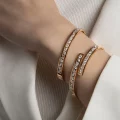
A solid bangle keeps its form and slips over the hand, sitting loosely and moving with you rather than following the wrist’s exact shape. A chain bracelet is softer and follows the wrist closely, giving a more fitted feel that layers well with a watch or other bracelets. A tennis bracelet carries a continuous line of diamonds and reads as the dressiest of the three. Every stone has to match its neighbours in size, cut, and colour for the line to look even.
| Shape | How it fits | Daily durability | What drives price | Safe as a gift? |
|---|---|---|---|---|
| Solid bangle | Slips over the hand, sits loose | High | Gold weight | Needs size check |
| Chain bracelet | Follows the wrist, adjustable clasp | High | Weight plus linkwork | Yes, safest |
| Tennis bracelet | Close fit, secure clasp needed | Medium | Total carat and stone match | Yes, if size known |
Karat and Weight: What Actually Drives the Price
Higher karats such as 21k and 22k give a deeper, warmer colour and hold value by weight. But they’re softer – a real consideration for a piece that knocks against desks, car doors, and countertops all day. 18k holds up better to that daily friction, which is why it’s the standard choice for chain designs meant to be worn constantly rather than saved for occasions. Weight itself is the other major price driver: a substantial bangle will always cost more than a delicate chain at the same karat, independent of design complexity.
Designs for Women
Women’s gold bracelet designs range from minimal chain styles suited to daily stacking, to wider cuff-style bangles that make more of a statement on their own. Rose gold chain styles have become especially popular for everyday wear, since the warmer tone pairs easily with both gold and silver-toned accessories. White gold bangles suit a more formal, monochrome look instead.
Designs for Men
Men’s gold bracelet designs tend toward heavier link chains and broader, plainer bangles, rather than delicate or stone-set styles. They prioritise weight and a clean finish over intricate detail. A curb-link or flat-link chain in 21k or 22k is the most common request, chosen for durability and a substantial look on the wrist rather than a decorative one.
Pricing: With and Without Stones
A plain gold bracelet is priced almost entirely by weight and karat, making it straightforward to compare across shops on a like-for-like basis. Once diamonds or other stones are added – as in a tennis bracelet – pricing changes. It depends on total carat weight across all stones, plus their cut, colour, and clarity, not gold weight alone. Two tennis bracelets of the same total carat weight can differ significantly in price if one uses more closely matched, higher-grade stones than the other.
Fit: The Detail Most Buyers Get Wrong
The bracelet should sit close to the wrist with a little movement. It shouldn’t slide over the hand or hang loosely enough to catch on clothing throughout the day. A tennis bracelet especially benefits from a secure, well-considered clasp, since it’s worn often and any weakness there is the most common point of loss. If buying as a gift and unsure of wrist size, a chain bracelet with an adjustable clasp is the safer choice over a fixed-size bangle.
Styling and Pairing
A tennis bracelet pairs naturally with a matching bangle or chain bracelet worn alongside it, and makes a lasting gift for her. For daily stacking, mixing a slim chain with one slightly wider bangle in the same gold tone tends to look more considered than several similar-width pieces layered together.
Caring for a Gold Bracelet
Bracelets take more daily contact and friction than most jewelry, so a few habits extend their life. Remove them before water, cleaning products, or heavy manual work. Store separately from other pieces to avoid surface scratching, and clean periodically with warm water and mild soap. Tennis bracelets should have their clasp and stone settings checked periodically, since a loosened prong is easy to miss until a stone is already gone.
Buying by Weight vs. Buying by Design
As with most gold jewelry in Saudi Arabia, bracelets are priced either primarily for their gold weight or primarily for craftsmanship. A plain solid bangle in 21k is priced close to its gram value, making it easy to compare between shops. A chain bracelet with intricate linkwork or a designed clasp carries a larger making charge relative to its weight, since the labour and design work form a bigger share of the final price. Knowing which you’re paying for before comparing quotes avoids the common mistake of judging two very different bracelets purely by their final sticker price.
A Practical Example: Choosing a First Bracelet
If this is your first gold bracelet and you’re unsure where to start, a mid-weight chain in 18k is a reasonable default. It’s durable enough for daily wear, doesn’t require exact wrist measurement thanks to an adjustable clasp, and pairs easily with a watch or a second bracelet later. Save the tennis bracelet or a heavier statement bangle for once you know how often you’ll actually wear bolder pieces day to day.
What the Pages Already Ranking Do Not Tell You
| Buyer question | Covered by the pages currently ranking? |
|---|---|
| How bangle, chain and tennis styles differ in wear | No ranking page compares the three shapes |
| Which karat survives daily wear best | Partly. One page lists karat differences without a wear recommendation |
| How a bracelet should actually fit | No page gives fit guidance |
| What makes one tennis bracelet cost more than another | No page explains stone matching |
| Which style is safest to buy as a gift | No page addresses gifting without a size |
Checked on 1 August 2026 against the live page text of results ranking in Saudi Arabia. Two of the ranking results are image-board pages carrying no buying guidance.
Choosing your bracelet
- Decide the shape first: bangle, chain or tennis.
- For daily wear, favour 18k for its hardness.
- Check the clasp, especially on a stone-set bracelet.
- Confirm it sits close but does not slide over the hand.
- Buying as a gift without a size? Choose an adjustable chain.
- Ask whether the price is weight-driven or linkwork-driven.
- For tennis bracelets, ask how closely the stones are matched.
- Ask about periodic prong checks to avoid losing a stone.
Choosing Between the Three Styles
If you’re unsure between the three, a chain bracelet is the safest first piece. It needs no exact measurement, layers easily with a watch, and suits both daily wear and dressier occasions equally well. Visit a boutique or book an appointment. Our team will check the fit on your wrist, and compare a few widths and karats side by side.
Frequently Asked Questions
What’s the difference between a bangle and a chain bracelet?
A bangle is solid and keeps its shape, slipping over the hand and moving loosely. A chain bracelet is softer and follows the wrist closely, giving a more fitted, adjustable feel that layers well with other pieces.
What makes one tennis bracelet more expensive than another?
Price depends on total carat weight across all stones, plus their individual cut, colour, and clarity. Two bracelets with the same overall carat weight can differ significantly in price depending on how well-matched and well-graded the individual stones are.
Which karat is best for a bracelet worn daily?
18k, because it’s harder and holds up better to the friction of daily contact with desks, car doors, and countertops than the softer, higher-purity 21k or 22k.
How should a bracelet fit on the wrist?
It should sit close with a little room to move, but not slide loosely over the hand or hang enough to catch on clothing or bags throughout the day.
Are gold bracelet designs different for men and women?
Yes. Men’s designs tend toward heavier link chains and broader, plainer bangles, prioritising weight and durability. Women’s designs range from delicate stacking chains to wider decorative bangles.
Is a tennis bracelet good for everyday wear?
It can be, if the setting is secure and well-made. Many people reserve it for occasions since a continuous line of diamonds benefits from careful handling.
What’s the safest bracelet style to buy as a gift?
A chain bracelet with an adjustable clasp, since it doesn’t require knowing an exact wrist measurement the way a fixed-size bangle does.
How do I care for a gold bracelet with stones?
Remove it before water, cleaning products, or manual work, store it separately from other jewelry, and have the clasp and stone settings checked periodically – a loosened prong is easy to miss until a stone is already lost.
Can I mix different bracelet styles on the same wrist?
Yes – mixing a slim chain with one slightly wider bangle in the same gold tone tends to look more intentional than stacking several similar-width pieces together.
How much does a plain gold bracelet cost compared to one with diamonds?
A plain bracelet is priced almost entirely by weight and karat, making it easy to compare across shops. Adding diamonds shifts pricing to depend heavily on total carat weight and stone quality, not gold weight alone.
What’s the most common gold bracelet request for men?
A curb-link or flat-link chain in 21k or 22k, chosen for its durability and substantial look rather than for decorative detail.
Should I buy a bracelet set to match a necklace?
It’s not required, but matching the metal tone across a bracelet and necklace, even from different collections, gives a more coordinated look than mixing gold colours.
Should I buy a bracelet by weight or by design?
A plain bangle priced by weight is easy to compare across shops, while a bracelet with intricate linkwork carries a larger making charge relative to its weight. Know which you’re paying for before comparing final prices between two very different designs.
What’s a good first gold bracelet to buy?
A mid-weight chain in 18k is a reasonable default. It’s durable for daily wear, adjustable without needing an exact wrist measurement, and easy to pair with a watch later.
Can a gold bracelet be resized after purchase?
Chains can usually be adjusted at the clasp. Bangles can sometimes be resized within a limited range, but it’s worth confirming with your jeweller before purchase if the fit feels uncertain.



 Contact Us
 My Account
 Find a Boutique