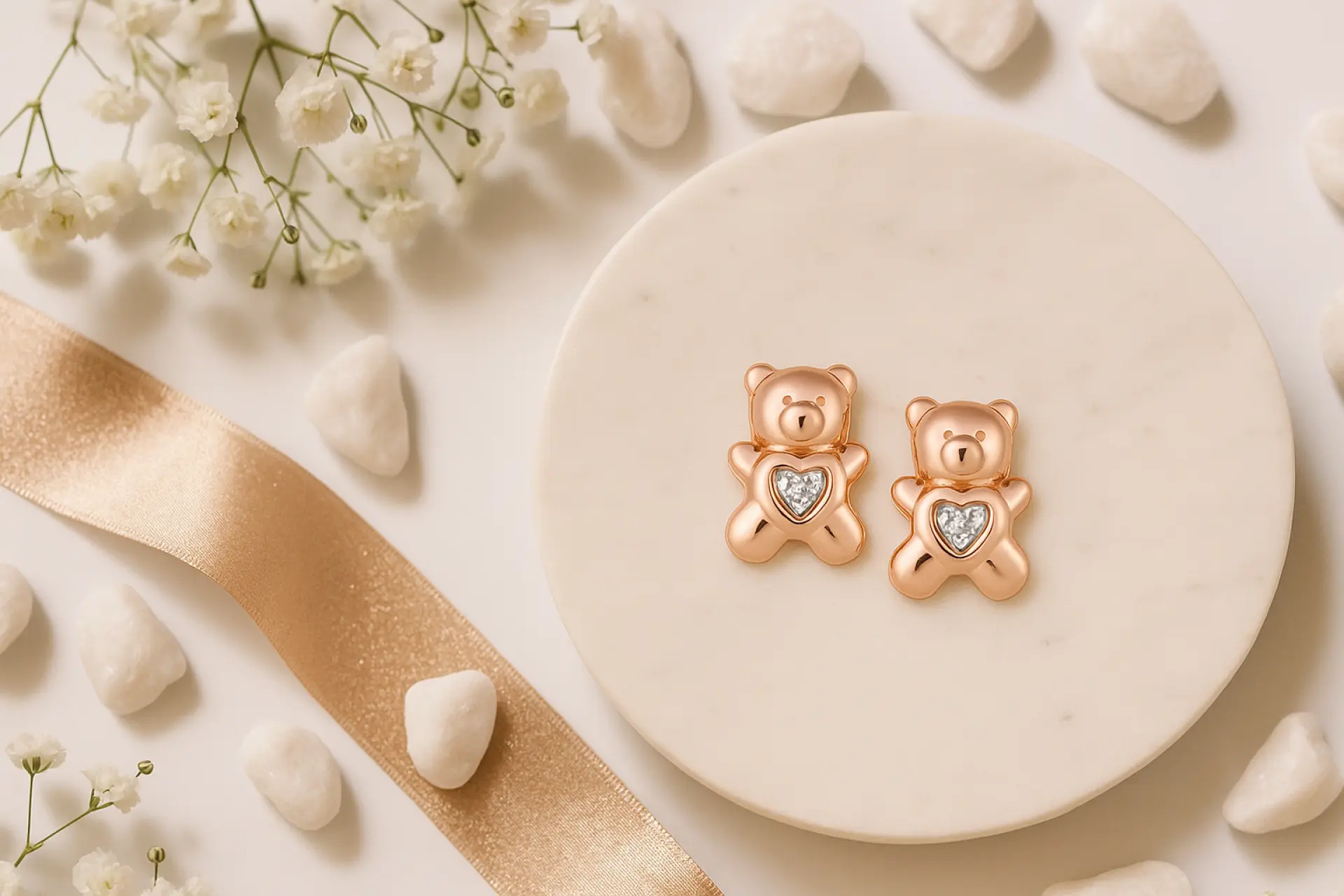
Baby jewellery is bought as a keepsake more often than as something worn every day, and the two purposes call for different pieces. This guide covers what is safe at each age, what to look for in the construction, and how to choose a piece that survives being grown out of. Safety questions come first, because they decide most of the rest.
Is it safe for a baby to wear jewellery?
The honest answer is that it depends on the age, the piece and the supervision, and that some pieces are safer as keepsakes than as everyday wear. Any decision about ear piercing or about a specific child’s skin should be made with your paediatrician rather than a jeweller, and nothing here replaces that advice.
What a jeweller can tell you is what makes a piece mechanically safer. Three things matter most: nothing that can detach and be swallowed, nothing that can catch and tighten, and no rough edges. Those three rule out most of what goes wrong.
What to look for in the construction
Check the fastening first. Screw-back earrings hold far more securely than push-backs, which is why they are the standard recommendation for young children. On necklaces and bracelets, the clasp should be small, smooth and secure, and the chain should be fine enough to break under real force rather than hold. A chain that will not give is more dangerous than one that will.
Then check the finish. Run a finger over the back of every piece: settings, clasp and the reverse of any pendant should be smooth, with no burrs or sharp points. Avoid anything with small applied parts such as glued stones or decorative beads that could work loose.
Finally, check the metal. Higher-karat gold is a common choice for children partly because it contains fewer alloy metals, and 18k is the practical balance between purity and durability. Ask what the piece is alloyed with if there is any known sensitivity in the family.
| Piece | Best as | Key safety point | Outgrown? |
|---|---|---|---|
| Screw-back studs | Everyday wear | Back cannot pull off easily | No |
| Fine pendant necklace | Keepsake, supervised wear | Chain must give under force | Chain yes, pendant no |
| Bangle or bracelet | Occasion wear | No loose or applied parts | Yes |
| Engraved keepsake piece | Kept, not worn | No wear risk | Never |
Buying a piece that will not be outgrown
This is where most baby jewellery disappoints, and it is entirely avoidable. A bangle sized to a one-year-old is unwearable within two years, while a pendant lasts a lifetime because only the chain needs replacing. If you want the gift to still matter at eighteen, buy the pendant and treat the chain as a consumable.
The same logic favours engraving. A name, a birth date or initials makes the piece specific to that child, and specificity is what turns jewellery into a keepsake rather than an item. Pieces from our Joy collection are designed at a scale that suits children without being childish, so they still read well later.
Everyday wear against keepsake
Decide which you are buying before you choose, because it changes everything. A keepsake can be more delicate, more detailed and more sentimental, since it will spend most of its life in a box and be worn on occasions. A daily piece has to be plainer, more securely fastened and more robust.
Trying to buy one piece that does both usually produces something too fragile to wear and too plain to treasure. Buying a simple pair of screw-back studs for daily wear and a separate engraved pendant as the keepsake serves both purposes better than one compromise piece.
Care and storage
Children’s pieces need the same care as adult ones, with more attention to checking. Take pieces off before bathing, swimming and sleeping. Clean with warm water, mild soap and a soft brush, and dry fully before storing. Check the fastenings roughly every few months, since screw backs can loosen with handling and clasps wear. Store each piece separately so chains do not tangle.
If a piece is bought as a keepsake and not worn, it still benefits from being kept dry and away from direct sunlight, and from being checked occasionally so a weakened clasp is not discovered years later.
Choosing a gift for a new baby
If you are buying for someone else’s child, keep two rules in mind. Avoid anything that requires a size, since babies grow unpredictably and a bangle that does not fit is not a gift. And avoid anything that implies a decision the parents have not made, particularly earrings for an unpierced child.
A pendant, an engraved keepsake, or a piece intended for the mother rather than the baby are all safer choices. Our guide to jewellery gifts for a new mother covers that second route, and the jewellery buying guide covers karat and metal basics if you are new to buying gold.
Metal sensitivity in young skin
Children’s skin reacts more readily than adult skin, and the usual cause is not the gold itself but the metals it is alloyed with. Nickel is the common culprit across jewellery generally. Higher-karat gold contains proportionally less alloy, which is part of why it is the usual recommendation for children, though no metal is guaranteed to suit every child.
If there is a known sensitivity in the family, ask what the piece is alloyed with before buying rather than testing it on the child. Any reaction that appears should go to your doctor rather than being managed by changing pieces.
Gifts by milestone
Baby jewellery is usually tied to a moment, and the moment suggests the piece. For a birth, an engraved keepsake with the date is the most durable choice because it never becomes the wrong size. For a first birthday, a fine pendant works, with the understanding that the chain will be replaced several times.
For older children moving into wearing jewellery daily, screw-back studs are the practical starting point, and a small bracelet with a secure clasp follows. The pattern across all of these is the same: buy the part that lasts, and treat the sized part as replaceable.
Keeping the paperwork
This is the step most people skip and later regret. Keep the receipt, any certificate, and a photograph of the piece. For an engraved keepsake intended to be handed over eighteen years later, a note recording who gave it and why is worth more than the packaging, and it is the part no jeweller can replace.
If the piece carries meaningful value, ask whether a valuation is available for insurance, and check whether your home policy covers jewellery kept but not worn. A keepsake in a drawer is still an item of value.
When to start
There is no single right age, and it is genuinely a family decision rather than a jewellery one. What changes with age is the practical risk: the younger the child, the more everything goes to the mouth, and the more a keepsake kept safely makes sense over a piece worn daily. As children get older, secure fastenings and supervision matter more than the piece itself.
If you are buying ahead of the age when a piece will actually be worn, the engraved keepsake is the choice that ages well, because it is meaningful at any point and carries no wear risk in the meantime.
| Buyer question | Covered by the pages ranking now? |
|---|---|
| Which fastenings are safer for a child | No section, none of the 8 |
| Which pieces get outgrown | No section, none of the 8 |
| Metal sensitivity in young skin | No section, none of the 8 |
| How to care for and store it | Only 1 of 8 |
We compared the section structure of the 8 pages ranking for this term in Saudi Arabia (August 2026). The table shows which questions they give a section to. What they leave out is what the sections above cover.
Before you buy, check these
- Decide first whether this is a daily piece or a keepsake.
- Choose screw-back fastenings over push-backs for young children.
- Run a finger over every surface to confirm there are no rough edges.
- Avoid glued stones or small applied parts that could work loose.
- Prefer a pendant over a bangle if you want it to outlast childhood.
- Ask about engraving to make it specific to the child.
- Raise any piercing or skin question with your paediatrician, not a jeweller.
Frequently asked questions
Is it safe for babies to wear jewellery?
It depends on the age, the piece and supervision, and questions about a specific child should go to your paediatrician. From a construction standpoint, the safer pieces have no detachable parts, no rough edges, and fastenings that hold securely, which is why screw-back studs are the usual recommendation over push-backs.
What kind of jewellery is safe for babies?
Pieces with nothing that can detach and be swallowed, nothing that can catch and tighten, and a smooth finish throughout. Screw-back earrings, and fine chains that will give under real force rather than hold, are the two most important construction points.
What is the best jewellery gift for a baby girl?
An engraved pendant, because it is the one piece that will not be outgrown. Only the chain needs replacing as she grows, and a name or birth date makes it a keepsake rather than an item. A bangle, by contrast, is usually unwearable within a couple of years.
Which gold is best for children’s jewellery?
18k is the practical balance: high enough in purity to contain fewer alloy metals, hard enough to resist the knocks a child’s piece takes. If there is any known metal sensitivity in the family, ask what the piece is alloyed with before buying.
What should I avoid when buying jewellery for someone else’s baby?
Avoid anything needing a size, since babies grow unpredictably, and avoid earrings for a child who is not pierced, since that is the parents’ decision to make. A pendant or an engraved keepsake avoids both problems.



 Contact Us
 My Account
 Find a Boutique