

 Contact Us

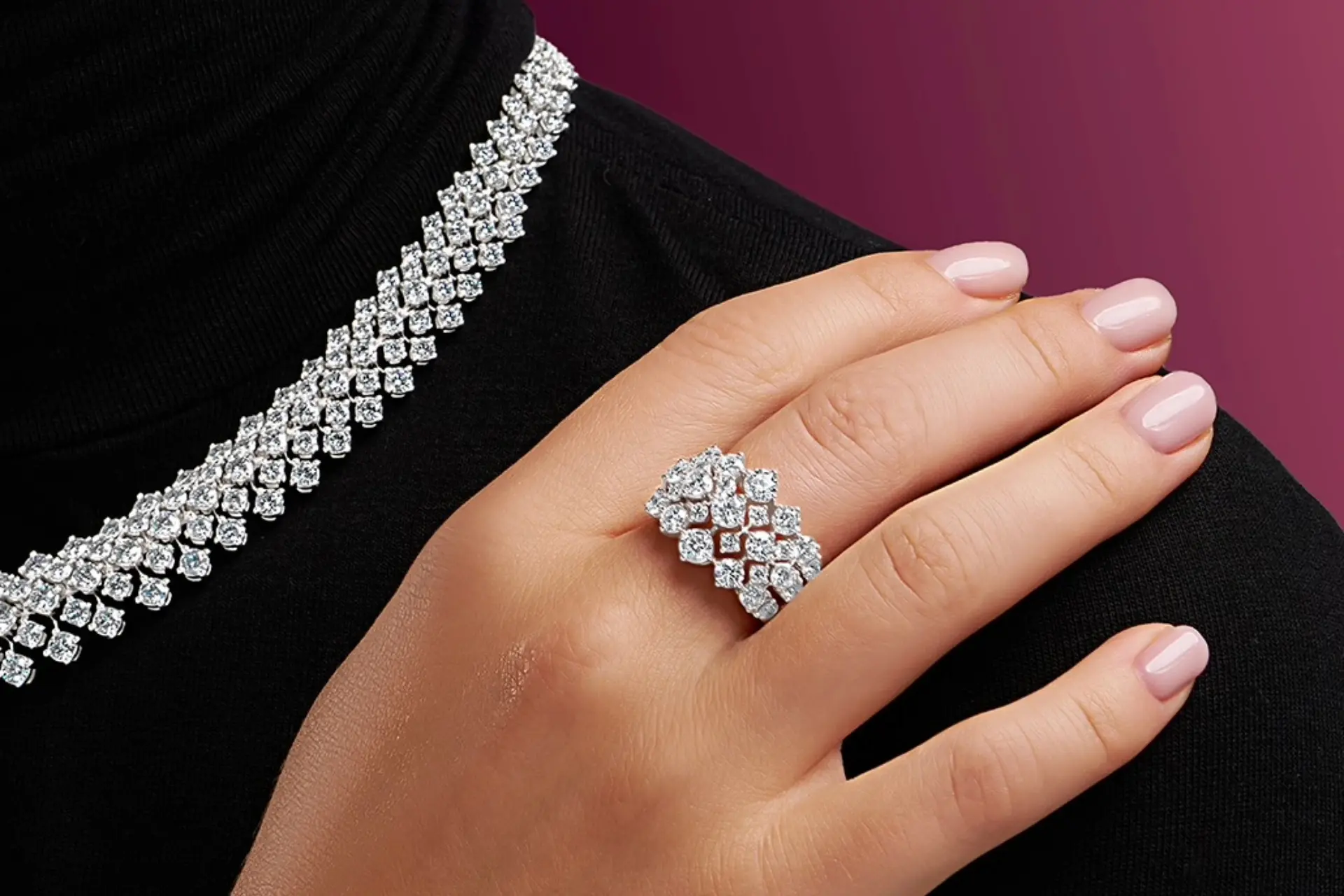
There is a particular kind of jewellery magic that happens when something old meets something beautifully made. A milgrain-edged vintage band sitting flush against a precisely set half eternity — the contrast deliberate, the result effortless. Stacking engagement rings and wedding bands has evolved into one of the most personal expressions in fine jewellery, moving far beyond the simple “bridal set” into something that reads more like a curated collection than a matched pair.
The Farah half-band is designed with exactly this in mind. Its proportions are generous enough to hold their own, refined enough to complement rather than compete. Paired with vintage and antique-style rings, it bridges eras — grounding the old in something current, giving the new a sense of history. This guide shows you how to build that stack with intention, whether you’re starting from a single vintage ring or layering an entire hand’s worth of meaning.
TL;DR — Quick Answer
Farah half eternity bands stack beautifully with vintage rings by balancing width, metal tone, and stone character. The key is mixing with intention: pair slim milgrain or pavé vintage bands alongside the Farah half-band to create depth without clutter. Alternate metal tones for an antique feel, or keep them uniform for a cleaner stack. Start with your most meaningful ring as the anchor and build outward.
Why Stacking Engagement Rings Has Become a Fine Jewellery Statement
The single solitaire worn alone was once the unquestioned standard. One ring, one finger, one statement. That convention still has its place — a beautifully cut solitaire on a bare finger is an exercise in confident simplicity. But the way people wear fine jewellery has shifted. Rings are increasingly worn in conversation with each other, each one adding a layer of meaning, memory, or aesthetic contrast that the single piece alone cannot carry.
Stacking engagement rings emerged not from a trend but from a very human impulse: the desire to mark multiple milestones on the same finger. An engagement ring. A wedding band. An anniversary band. A ring passed down. Each has a story, and the stack tells all of them simultaneously. What started as a practical question — how do you wear multiple meaningful rings without looking cluttered? — became its own art form with its own vocabulary.
Vintage ring stacking adds another dimension. Mixing old-cut diamonds, Art Deco geometric bands, and Victorian-influenced milgrain edges with modern half eternity designs creates a layered history on the hand. The stack becomes something personal and irreplaceable — a collection no jeweller could replicate from a single catalogue page. For those exploring the full spectrum of bridal jewellery possibilities, understanding the difference between a wedding ring and an engagement ring is a useful starting point, particularly when building a stack that will grow to include both over time.
What Makes the Farah Half-Band a Natural Stacking Ring
Not all bands are designed with stacking in mind. Some are too wide, too tall, or too visually dominant to sit comfortably alongside other rings without overwhelming them. The Farah half-band avoids all of these problems by design. Its proportions are deliberate: a width that registers clearly on the finger without monopolising it, a setting height that keeps the profile slim enough to nest against other bands without creating uncomfortable gaps.
The half eternity format — diamonds set across the top half of the band only, leaving the underside plain — is one of the most practical stacking formats in fine jewellery. It sits flat against the finger in a way that a full eternity band sometimes cannot. Full eternity bands require precision sizing because they cannot be adjusted, and they can feel rigid when stacked tightly against other rings. The half eternity is more forgiving on both counts.
The Farah half-band’s stone setting — whether pavé, channel, or prong-set — runs in a clean continuous line across the top of the band, creating a streak of brilliance that catches light while remaining flush and comfortable against the skin. This geometry makes it an excellent companion to vintage rings with more complex, surface-level detail, because it adds sparkle without competing with the architectural intricacy of an Art Deco or milgrain-edged piece. For a broader view of how the Farah design family expresses itself across different formats, the Farah collection at Kooheji Jewellery is an excellent reference point.
Understanding the Vintage Aesthetic: What Makes a Ring Look Antique
Before you can stack vintage rings well, you need to understand what actually makes a ring look vintage — because “vintage style” is not a single aesthetic. It’s a family of influences spanning more than a century, each with its own geometry, stone character, and surface treatment.
Art Deco rings — 1920s to 1930s in origin or inspiration — are characterised by geometric precision, high contrast between platinum or white gold and diamonds, and strong linear patterns. They stack exceptionally well with modern white gold half eternity bands because the aesthetic language is consistent: clean lines, precise settings, brilliant stones. Victorian and Edwardian rings occupy a softer territory — filigree metalwork, rose gold settings, old mine cut diamonds, and delicate floral motifs. These rings create beautiful contrast when stacked against the more modern, linear geometry of a half eternity band. The visual tension between the two aesthetics is precisely what makes the combination interesting.
Milgrain edging — those tiny beaded borders that appear on so many vintage and vintage-style bands — is one of the most important details to look for. When your half eternity band and your vintage pavé band both feature milgrain borders, the stack reads as cohesive even if the two rings come from entirely different design periods. Old-cut diamonds — mine cuts, European cuts, and rose cuts — produce a warmer, softer glow than modern brilliant cuts, and when stacked alongside a modern half eternity set with ideal-cut stones, this contrast in light character adds genuine depth to the overall composition.
Half-Band Stacking Combinations That Work
The art of the vintage ring stack lies in knowing which combinations create harmony and which create noise. The following are the most reliable stacking configurations to guide your choices:
- The Classic Three-Ring Vintage Stack — A central anchor ring flanked by one band on each side. A vintage milgrain solitaire at the centre, the Farah half-band on one side, and a slim Art Deco-inspired pavé band on the other. The half eternity’s continuous stone line balances the solitaire’s single focal point while the pavé band adds a third layer of brilliance without repeating the same visual element twice. Vintage glamour stacking at its most composed.
- The Two-Band Wrap — Two bands flanking a central vintage ring for a symmetrical arrangement. Two Farah half-bands — one in white gold, one in rose gold — set against a central vintage rose gold pavé band creates a tonal composition that reads as warm and layered. The white gold half eternity adds contrast while the rose gold anchor holds the warmth. Particularly effective on fair to medium skin tones where metal contrast is most visible.
- The Asymmetric Vintage Stack — Building outward from the base of the finger with rings at graduated positions rather than symmetrically flanking a centre piece. A vintage wedding band at the base, the Farah half-band in the middle, and a slim antique ring closer to the knuckle creates a gradient of visual weight that draws the eye upward. Works especially well on longer fingers where there is physical space to develop the composition.
- The Tonal Monochrome Stack — All white gold or all yellow gold across the entire arrangement, with variation coming from surface texture rather than metal contrast. A smooth half eternity, a milgrain-edged vintage band, and a channel-set antique ring create three distinct textural signatures in the same metal family. In an all-yellow stack, the vintage character naturally dominates — yellow gold has a warmth that reads as antique even on modern designs.
Mixing Metals in a Vintage Stack
Metal mixing used to be the great taboo of fine jewellery — the convention was that you picked a metal and committed to it across every piece. That convention has dissolved in contemporary fine jewellery, and vintage stacking is where mixed metals look most natural. The reason is historical: antique rings were made in whatever metal was fashionable at the time. A Victorian rose gold ring sitting alongside a 1930s platinum Art Deco band and a contemporary white gold half eternity is as historically accurate as it is aesthetically deliberate.
The most effective metal mixing follows one of two approaches. The first is tonal pairing — yellow gold with rose gold, or white gold with platinum. These create warmth or coolness within a controlled palette and feel cohesive because the colour families are related. The second is deliberate contrast — white gold alongside yellow gold, or platinum alongside rose gold — creating a more visually active stack that reads as intentionally curated.
The key to making mixed metals look intentional rather than accidental is repetition. If you introduce rose gold into a primarily white stack, that rose gold element should appear at least twice in the arrangement. A single rose gold band in an all-white stack reads as a mistake. Two rose gold elements in that same stack read as a decision. That distinction — between accident and intention — is everything in a well-built vintage ring stack.
Getting the Proportions Right
Proportion governs everything in a ring stack. The relationship between band widths, stone sizes, and finger length determines whether the overall composition reads as elegant or overwhelming. The following principles keep the proportions in check:
- Follow the width gradient rule — The widest ring should be the anchor piece. Flanking bands should be equal to or narrower than the anchor. A 3mm anchor works well with 2mm flanking bands. Flanking bands wider than the anchor invert the visual hierarchy and create an unbalanced impression.
- Match stone scale to context — If your vintage ring features large old-cut diamonds, pair it with a half eternity set with fine pavé stones. The large stones anchor the stack while the pavé adds background sparkle. Mismatching large stones with large stones creates visual competition rather than harmony.
- Consider your finger length — Short fingers benefit from two or three slim bands rather than four wide ones. Long fingers can carry more elaborate multi-ring stacks without looking cluttered. When uncertain, build incrementally — start with two rings and add a third only after seeing how the first two perform together on the actual hand.
- Mind the total stack width — The combined width of all rings in the stack should not extend beyond the natural width of the finger. A stack that spreads past the fingertip edges on either side reads as excessive regardless of how beautiful the individual rings are.
How to Build Your Stack Over Time
The most meaningful vintage ring stacks are not assembled all at once. They grow. A new band for an anniversary. A vintage ring inherited or discovered. A half eternity added to mark a milestone. The cumulative stack becomes a record of time — each ring dateable to a specific moment, the overall arrangement something that could only belong to one person.
Starting the stack well makes the growth process easier. The first ring — whether a vintage solitaire, a half eternity, or an inherited piece — should be treated not just as a ring but as an anchor. Its proportions, metal tone, and aesthetic character set the parameters for everything that follows. If the anchor is strongly vintage in character, future additions should either echo that character or deliberately contrast with it. Ambiguity in the anchor ring makes subsequent choices significantly harder.
When adding to an existing stack, always bring the current stack with you — or at minimum, photos of it worn on the finger. This lets you assess how a new ring will sit in proportion and how its metal and stone character will interact with what is already there. Many regrettable stacking decisions happen when rings are evaluated individually rather than as part of an existing composition. Vintage rings acquired over time from estate sales or antique markets make the most interesting additions because they carry genuine history that vintage-inspired modern bands cannot entirely replicate. The full range of ring designs at Kooheji Jewellery spans both directions — genuine vintage character and precision modern craft — making it a useful reference when adding to an existing stack.
There is also the question of when to stop. A stack has a natural visual ceiling — the point at which adding another ring tips the composition from curated to cluttered. The test is simple: does the new addition strengthen the overall composition, or does it compete with it? If you find yourself uncertain, the answer is usually to wait. The right ring announces itself clearly.
FAQ
Can I mix genuine antique rings with modern half eternity bands?
Yes, and this combination often produces the most interesting results. The contrast between the handcrafted character of a genuine antique ring and the precision of a modern half eternity creates visual depth that all-modern or all-antique stacks cannot replicate. Ensure the band widths relate to each other proportionately — that is the primary factor in making the combination look intentional.
Do all the rings in a stack need to be the same size?
They should all fit your finger comfortably, which typically means the same size. Slight variations of half a size are usually manageable with slim bands. Wider bands often need to be sized marginally larger than slim bands to achieve the same comfort. If sizing multiple rings for a stack, try them together on the finger during the process — individual sizing without the full stack present can produce an uncomfortable result.
How do I prevent stacked rings from spinning or shifting?
Stacked rings tend to stay in place better than individual rings because adjacent bands support each other. If spinning is an issue, a sizing bar soldered inside the band is a standard and effective solution. Ensuring the stack is tight enough that the rings press gently against each other usually resolves the problem naturally without any modification.
What stone types work best in vintage stacking bands?
Old mine cut and European cut diamonds are the most historically authentic choice and produce a warm, distinctive glow that contrasts beautifully with modern brilliant cuts. Sapphires, rubies, and emeralds in Art Deco settings add colour and period character. For a subtler vintage look, rose-cut diamonds or champagne stones work well alongside modern half eternity bands, creating a soft tonal contrast rather than a sharp one.
Is there a rule about how many rings to wear in a stack?
No fixed rule — but most stacks look most intentional at two to four rings. Below two, it is a pairing rather than a stack. Above five, the composition usually starts to lose coherence unless the rings are uniformly slim and the hand is proportionately large enough to carry the visual weight. Three rings remains the most common and reliable sweet spot.
Conclusion
Stacking engagement rings with vintage bands is one of the most personal things you can do in fine jewellery. It is not about following a formula — it is about understanding the principles well enough to make decisions with confidence. Width relationships, metal tone choices, stone character contrasts, and the gradual accumulation of pieces over time: these are the variables that turn a collection of rings into a cohesive, evolving composition.
The Farah half-band earns its place in a vintage stack because it was designed with exactly this versatility in mind. Its proportions are generous without being dominant, its stone line precise without being cold, and its setting style compatible with the textural vocabulary of vintage and antique jewellery. Whether used as an anchor, a flanking band, or a daily-wear edit, it becomes more interesting the more it is worn alongside rings with history.
At Kooheji Jewellery, the approach to stacking rings is rooted in the understanding that the best jewellery is worn, layered, and personalised over time. Explore the full wedding and bridal ring collection, browse the best diamond engagement ring designs for stack anchor inspiration, and discover the combinations that speak to your particular sense of history and style. The right stack reveals itself when you stop looking for the perfect answer and start building something that is simply, unmistakably yours.


 My Account
 Find a Boutique