There’s a moment — somewhere between the jeweller’s loupe and the velvet display tray — when you stop asking “which diamond is most beautiful?” and start asking something far more personal: which diamond is most beautiful on me?
It’s a shift worth making. A stone that dazzles in isolation can look underwhelming — or overwhelming — on the wrong hand. Finger length, palm width, knuckle prominence: your hand is not a neutral backdrop. It’s a living variable in the equation. The right diamond cut doesn’t just sit on your finger. It transforms it.
This guide gives you the full picture — shape by shape, hand type by hand type — so you can stop guessing and start knowing.
TL;DR — Quick Answer
Elongated shapes (oval, marquise, pear) make fingers look longer. Round brilliant cuts flatter nearly every hand type. Princess cut suits balanced, medium hands. Avoid wide shapes on short, wide fingers. Match band width to your finger’s natural width for the most proportionate result. Read on for your specific hand type.
Why Diamond Shape Affects How Your Hand Looks
Optical illusion is not a trick reserved for art galleries. It is, in fact, the entire science behind choosing a flattering diamond cut. The human eye reads lines and shapes in predictable ways — vertical lines elongate, horizontal lines widen, pointed silhouettes draw the gaze upward, and round shapes distribute visual weight evenly.
A marquise diamond has two sharp points aligned along the finger’s axis. That vertical orientation creates the visual effect of length, making fingers appear slimmer and more elongated. Contrast that with a cushion cut — broad, square, soft-cornered — which distributes visual mass horizontally and can make a compact finger look even more so.
None of this means one shape is objectively superior. Every shape has a natural environment where it thrives. Understanding the full anatomy of a diamond cut — its proportions, facet structure, and outline — is the first step toward making a choice that works with your hand, not despite it. And understanding how diamond cuts interact with light helps you decide what role you want your ring to play: drama, elegance, understated brilliance, or pure fire.
Know Your Hand Type First
Before matching a diamond to your hand, you need an accurate read of what you’re working with. Look at your hand with fingers together, relaxed, palm facing down. Four questions guide the assessment:
Are my fingers short or long? If your middle finger roughly matches your palm length, you’re proportionally average. Noticeably shorter means short fingers; visibly longer means long.
Are my fingers wide or slender? Run your thumb along the side of your index finger. Is there significant width, or is it narrow and tapered?
Is my overall hand small or large? Ring sizes 4–5.5 are petite; 6–7 are average; 7.5 and above are on the larger side.
Are my knuckles prominent? This affects which settings sit comfortably and which look cluttered. Once you’ve assessed these four dimensions, the matching process becomes far more intuitive.
At a Glance: Diamond Shapes & Their Best-Suited Hand Types
- Oval Cut — The most universally flattering elongated shape. Ideal for short fingers, petite hands, and wide fingers seeking visual length without excess bulk.
- Round Brilliant — Classic, balanced, and the world’s bestselling shape. Works equally well on long, large, and average hands. The safest choice for most buyers.
- Marquise Cut — Maximum elongation effect. Best for short or wide fingers that want dramatic visual length. Bold silhouette with directional impact.
- Pear (Teardrop) — Elegant hybrid with a rounded base and pointed tip. Suits short fingers and petite to average hands looking for softness with direction.
- Princess Cut — Clean geometric square with high brilliance. Best suited to long, slender, or balanced medium hands with room for the square outline.
- Emerald Cut — Step-cut rectangle with refined, mirror-like reflection. Surprisingly flattering on wide fingers when set with a slim band and vertical orientation.
- Cushion Cut — Soft square outline with exceptional brilliance. Suits large hands and long fingers that can carry the full visual weight of the shape.
- Radiant Cut — Brilliant-faceted rectangle with a bold outline. A strong choice for large or long hands that benefit from its generous spread and sparkle.
Best Diamond Shapes for Short Fingers
Short fingers benefit most from shapes that create a vertical visual line — one that pulls the eye upward along the finger rather than across it. The goal is visual elongation, and several cuts deliver it exceptionally well.
Oval cut is arguably the single most flattering shape for short fingers. Its elongated ellipse runs along the length of the finger, creating an unbroken upward line from knuckle to tip. It also reads larger than its actual carat weight, giving you visual presence without physical bulk — an important advantage when working with smaller-scale proportions.
Marquise cut maximises the elongation effect even further. With pointed ends at both tips, it can add the visual equivalent of a full finger length. It is a bold and dramatic silhouette, but for those who want maximum impact, it delivers without compromise.
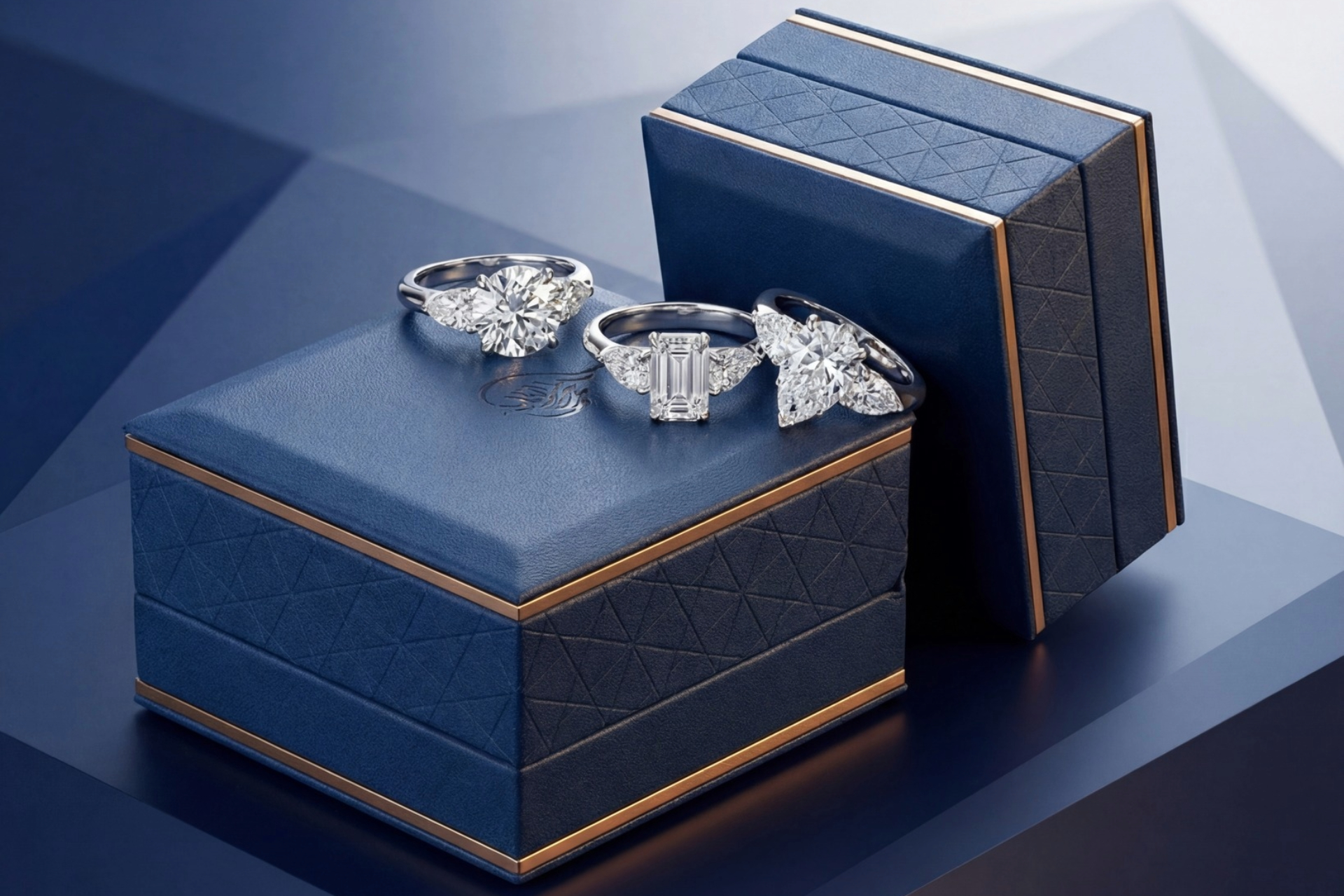
Pear cut is a refined middle ground. The rounded base softens the hand while the pointed tip draws the eye upward. Worn with the point toward the nail, it creates a lengthening effect that is elegant and directional. The Farah Teardrop Solitaire Ring with Baguette Side Stones is a precise expression of this pairing — the tapered baguettes framing the central stone add architectural length that complements shorter fingers beautifully.
What to avoid: wide, horizontally-oriented shapes like the Asscher cut and broad cushion cuts emphasise compactness rather than counteracting it. They are not off-limits, but they require careful band choices and slim settings to compensate for their natural horizontal spread.
Best Diamond Shapes for Long Fingers
Long, slender fingers are often considered the ideal canvas for a diamond ring — and while that’s partly true, the reality is more nuanced. Very long fingers can make smaller stones look insignificant. Fuller, wider shapes actually balance an elongated hand beautifully by creating a horizontal counterpoint to the finger’s natural length.
Round brilliant cut sits perfectly on long fingers. Its circular symmetry balances the finger’s length without drawing attention in any single direction. It is classic, universally flattering, and never reads as mismatched on long hands. The Farah Round Brilliant Solitaire Ring with Tapered Baguettes exemplifies this pairing — the clean solitaire setting lets the brilliant cut lead, while tapering baguettes add subtle directional detail at the band without visual excess.
Princess cut also performs exceptionally well on long fingers. Its square shape creates a horizontal break in the visual line of the finger, giving the ring a sense of grounded presence and stopping it from disappearing into the hand’s natural length.
Long fingers can carry larger carat weights more comfortably. A 1.5 or 2-carat stone that might look extravagant on a petite hand reads as poised and proportionate on longer fingers. Cushion and radiant cuts are also strong options, with their full outlines filling the hand in a way that feels balanced rather than excessive.
Best Diamond Cuts for Small or Petite Hands
Petite hands — characterised by a small overall palm size and shorter, finer fingers — have a particular sweet spot when it comes to diamond shapes. The wrong choice can overwhelm the hand or look lost on it. The right choice looks intentional, as though the ring was designed for that hand specifically.
Round brilliant is an evergreen choice for petite hands. Its compact, symmetrical outline doesn’t dominate the finger, and its exceptional brilliance ensures it still commands attention. A 0.5 to 1.2 carat round brilliant typically sits in ideal proportion on petite fingers.
Oval cut is an excellent alternative. As mentioned, it reads larger than its carat weight due to its elongated spread, which means you gain visual presence without physical excess. On a petite hand, this is a significant advantage.
What petite hands generally want to avoid is anything too wide, too chunky, or too clustered. Heavy halo settings, thick bands, and oversized cushion cuts can overpower small hands. The key is always balance — a stone that asserts itself without dominating. Kooheji Jewellery’s Farah collection includes designs scaled with precisely this proportion in mind, making it a strong starting point for petite-hand shoppers.
Best Diamond Cuts for Wide Fingers
Wide fingers are the most underserved hand type in mainstream diamond advice. The standard guidance — “go elongated” — is correct but incomplete. Wide fingers also benefit from careful band width management and smart setting geometry that reinforces the vertical line.
Oval and marquise remain top recommendations here, for the same elongation reasons. But specific orientation matters more on wide fingers. The oval’s longer axis must run along the finger for the effect to work. A round oval set in a wide, thick band can negate the elongating effect entirely.
Emerald cut is a surprising strong performer on wide fingers when set correctly. Its long rectangular shape creates clear vertical lines, and its step facets produce a sleek, mirror-like reflection that reads as refined rather than busy. The Farah Emerald Cut Solitaire Ring with Baguettes in White Gold exemplifies this — the clean geometry of the emerald cut combined with linear baguette side stones creates a continuous vertical line that is extremely flattering on wider hands.
A slender band makes a significant difference for wide fingers. A thin, delicate band emphasises the stone and draws the eye vertically — the exact optical effect you want. Avoid: round brilliants at very wide settings, square-cut stones set in wide flat bands, and any design that extends horizontally across the full width of the finger.
Best Diamond Cuts for Large Hands
Large hands — broader palms, longer fingers, larger ring sizes — can carry stones that would overwhelm smaller ones. A 2-carat round brilliant that looks extravagant on a size-5 finger reads as elegantly balanced on a size-8. But size alone doesn’t determine the right match — proportion still governs the final impression.
Cushion cut and radiant cut are particularly strong options for larger hands. Their full, lush outlines fill the finger proportionally, and their exceptional brilliance means they register impressively from a distance — which matters more on larger hands where the stone needs to carry across more visual space.
What doesn’t work as well: very small stones on large hands. A 0.5-carat round brilliant on a size-8 hand can look like a decorative chip rather than a centrepiece. For larger hands, think of 1.2 carats as a starting floor rather than a ceiling. Very delicate micro-pavé bands paired with large stones on big hands can also look mismatched — the setting needs to match the stone’s scale.
How Carat Weight Plays Into Hand Proportions
Carat weight and diamond shape are not independent variables. An oval and a round diamond of identical carat weight will look like different sizes on the hand — the oval appears larger because its shape spreads the weight across a greater visible surface area. This matters in two important ways.
First, it means you can achieve the visual appearance of a larger stone without the price premium that comes with higher carat weight — a significant consideration given how carat weight influences diamond pricing. Second, it means carat weight alone is a misleading guide to how impressive a ring will actually look on your hand.
For petite or small hands, prioritise shapes with a high surface-to-weight ratio — oval, marquise, pear. These give maximum visual presence per carat. For larger hands, depth and brilliance matter more than surface spread, making round brilliants and cushion cuts strong investments. There is also the matter of physical comfort. A very large stone on a slender finger can feel top-heavy and uncomfortable for daily wear — comfort is part of the equation, not an afterthought.
Band Width and Setting Style: The Unsung Variables
The diamond attracts all the attention, but the band is doing as much work. A wide band on a short finger adds horizontal weight and visual compactness. A thin, knife-edge band on the same finger draws the eye along the vertical plane and creates breathing room around the stone.
The practical rule: band width should roughly mirror finger width. Slender fingers suit bands of 1.5–2mm. Average fingers wear 2–2.5mm comfortably. Wider fingers can carry 2.5–3.5mm without losing proportion. Setting height also plays a role — a high solitaire setting lifts the stone and creates vertical emphasis, while a bezel setting wraps the stone flush to the band, adding a sleek contemporary feel.
Browsing the full engagement ring collection at Kooheji Jewellery gives you a clear sense of how setting style transforms the same diamond shape into dramatically different aesthetics. The stone and the setting are a conversation — they should speak the same language.
Band & Setting Quick Reference Guide
- Thin Band (1.5–2mm) — Ideal for petite and slender fingers. Emphasises the stone vertically and creates a delicate, elongating effect. Pairs best with oval, pear, and round brilliants.
- Medium Band (2–2.5mm) — Suits average hands most naturally. Offers balance between presence and delicacy. Works with nearly all diamond shapes without overriding the stone.
- Wider Band (2.5–3.5mm) — Proportionate for larger or wider fingers. Needs an elongated stone shape alongside it to avoid adding horizontal visual mass.
- High Solitaire Setting — Creates vertical lift and visual elongation. Best for short or wide fingers seeking additional perceived length and an airy, elevated look.
- Bezel Setting — Sleek, protective, and modern. Reduces visual height — ideal for active lifestyles, long fingers, and contemporary aesthetics.
- Pavé Band — Adds brilliance across the entire band length. Flatters oval and round cuts; requires careful scaling on very small or petite hands.
- Channel-Set Baguettes — Clean architectural lines flanking the centre stone. Excellent paired with emerald, princess, or rectangular cuts for a geometric, refined result.
- Tapered Baguette Sides — Elongate the stone visually and draw the eye along the finger. A subtle method of adding perceived length without changing the diamond shape itself.
FAQ
Does skin tone affect which diamond cut looks best?
Skin tone influences metal choice more than diamond shape. Warmer tones pair beautifully with yellow or rose gold; cooler tones suit white gold and platinum. A high-contrast setting — white metal with a brilliant cut stone — shows off sparkle more starkly, which reads as striking or harsh depending on the overall composition you’re building.
Should I prioritise cut quality or carat weight?
Cut quality, always. A poorly cut 1.5-carat diamond looks flat and lifeless. A precisely cut 0.9-carat stone looks alive, brilliant, and larger than its weight suggests. The craftsmanship of the cut determines how light behaves inside the stone — which is what makes a diamond actually look like a diamond.
Can an elongated shape make long fingers look even longer?
Not significantly. The elongation effect of oval or marquise cuts is most pronounced on fingers that lack natural length — it creates an illusion of something absent. On long fingers, the shape simply harmonises with existing proportion rather than exaggerating it.
Yes. For men’s diamond rings with wider bands, geometric cuts — princess, cushion, emerald — tend to look proportionate on broader fingers. Bezel or tension settings give round brilliants a more architectural, contemporary feel. The same elongation principles apply, but men’s rings generally benefit from designs with more structural mass and presence.
What is the most universally flattering diamond shape overall?
The round brilliant cut accounts for roughly 60% of all diamond purchases globally — and for good reason. Its 58 precisely angled facets maximise light performance across all conditions, and its circular symmetry flatters every hand type without making a directional statement. It is the safest choice and, frequently, the most satisfying one.
Conclusion
The best diamond cut for your hands isn’t a universal answer — it’s a personal one. It lives at the intersection of your finger length, palm width, lifestyle, and the visual story you want your ring to tell.
Elongated shapes like oval, marquise, and pear create length and elegance on shorter or wider fingers. Round brilliants offer timeless flattery across virtually every hand type. Emerald and princess cuts suit balanced hands or long fingers looking for geometric precision. What ties all of it together is proportion — the relationship between stone size, band width, setting height, and the natural architecture of your hand.
Get the proportions right, and almost any shape can look extraordinary. Ignore them, and even the most expensive stone can miss the mark. At Kooheji Jewellery, every piece in the collection is designed with this craftsmanship in mind — where the geometry of a stone is as considered as the quality of it. Whether you’re drawn to the drama of a pear solitaire, the clean lines of an emerald cut, or the unbeatable brilliance of a round brilliant, there’s a design that was made for your hand specifically.
Explore the full range at Kooheji Jewellery’s Farah collection, browse solitaire ring designs, or shop the complete engagement ring selection to find the cut that was made for you.



 Contact Us
 My Account
 Find a Boutique