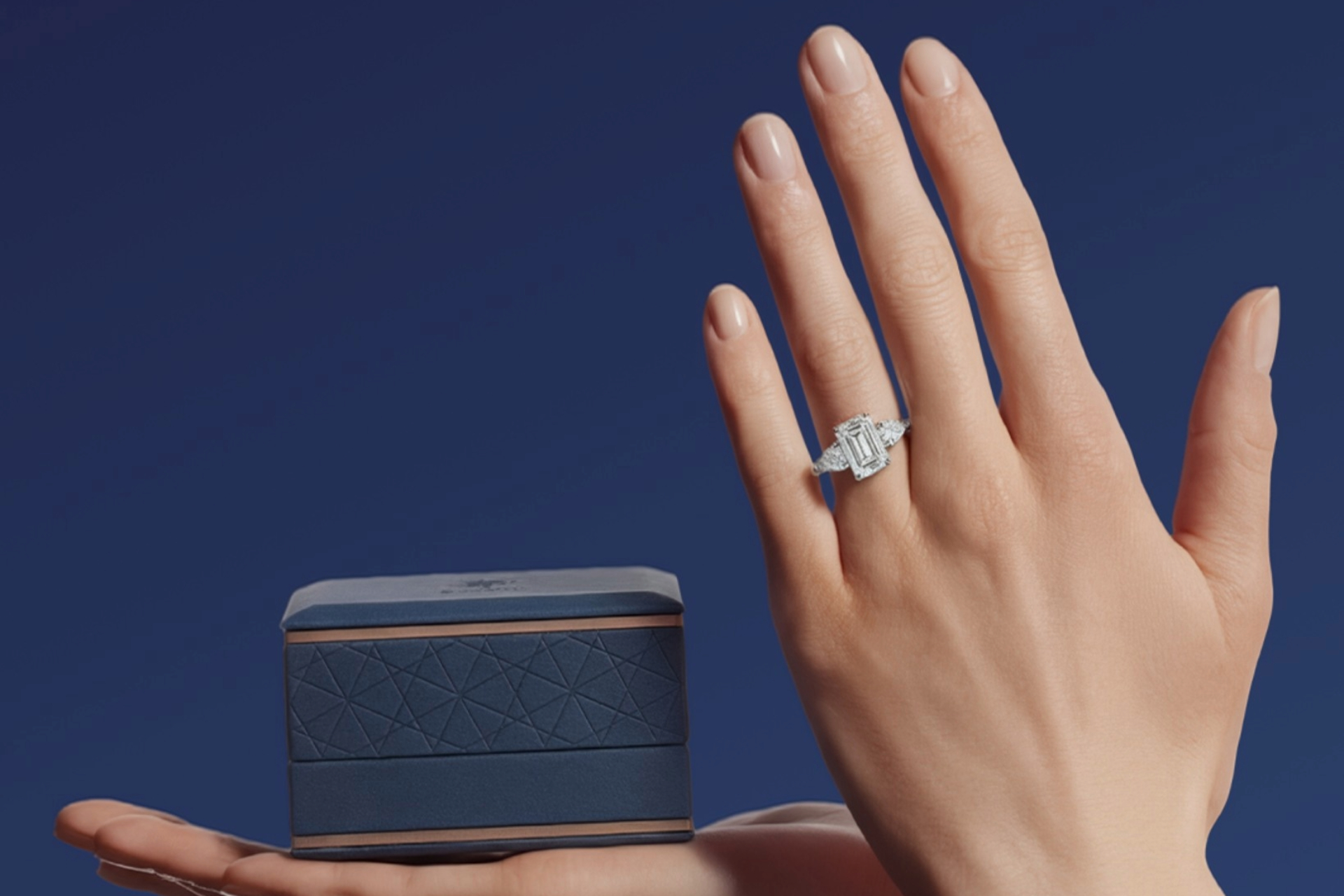
Carat is the word everyone reaches for first. It’s the number on the certificate, the figure in the listing, the detail dropped into conversations about engagement rings. And yet, for most buyers, it’s also the most misunderstood dimension of a diamond purchase — and cut quality is what drives brilliance.
Carat measures weight — not size. Not diameter. Not how large a stone looks on the finger. Two diamonds of identical carat weight can appear visibly different depending on their cut, shape, and depth. A round brilliant and a pear cut weighing exactly the same will look like different sizes. That’s not a trick. That’s physics.
This guide gives you a clear, practical solitaire carat size comparison — from 0.5 carats to 3 carats — so you can see what each weight actually looks like on a hand, understand what drives the visual difference, and make a purchase decision grounded in reality rather than marketing numbers.
TL;DR — Quick Answer
A 1 carat round brilliant measures approximately 6.4–6.5mm in diameter. A 1.5 carat measures around 7.3–7.4mm. A 2 carat reaches roughly 8.1–8.2mm. The visual jump between sizes feels significant in person but depends heavily on cut quality, finger size, and setting style. For most average-sized hands, 1 to 1.5 carats is the sweet spot for presence without excess. Read on for the full breakdown.
Carat vs. Size: The Distinction That Changes Everything
One carat equals 0.2 grams — a unit of mass, standardised globally across the diamond trade. What it doesn’t define is appearance. The visual size of a diamond is determined by its diameter and face-up surface area, both of which are shaped by cut proportions rather than weight alone.
A diamond cut with a deep pavilion carries more of its weight below the surface, hidden inside the setting. That stone looks smaller face-up than a shallower-cut diamond of the same carat weight. Conversely, a stone cut too shallow spreads its weight across a wider surface but loses brilliance in the process. The ideal cut balances both: a diameter that reads well on the finger and a depth that optimises light return.
This is why cut quality is the most consequential factor in a diamond purchase — more so than carat weight, and arguably more so than colour or clarity. A well-cut 1 carat diamond looks larger and more brilliant than a poorly cut 1.5 carat. That comparison plays out in real showrooms every day, and it surprises buyers every time. Understanding this distinction shifts the entire framework: you stop chasing a certificate number and start evaluating what a stone actually delivers when set and worn.
Diamond Carat to Millimetre Chart for Round Brilliants
The round brilliant is the global benchmark for carat size comparisons because its circular outline makes diameter measurements consistent and easy to reference. The following figures represent well-cut stones within standard proportions. Actual measurements will vary slightly depending on individual cut depth.
- 0.25 carat — approximately 4.1mm diameter
- 0.50 carat — approximately 5.1–5.2mm diameter
- 0.75 carat — approximately 5.8–5.9mm diameter
- 1.00 carat — approximately 6.4–6.5mm diameter
- 1.25 carat — approximately 6.9–7.0mm diameter
- 1.50 carat — approximately 7.3–7.4mm diameter
- 1.75 carat — approximately 7.7–7.8mm diameter
- 2.00 carat — approximately 8.1–8.2mm diameter
- 2.50 carat — approximately 8.9–9.0mm diameter
- 3.00 carat — approximately 9.3–9.4mm diameter
Notice how the diameter increments shrink relative to carat increases at the higher end. Going from 0.5 to 1 carat nearly doubles the weight but adds only about 1.3mm of diameter. Going from 2 to 3 carats adds 50% more weight but gains only 1.2mm. The visual returns diminish as carat weight climbs — a pattern with real implications for both budget and appearance. These figures apply to round brilliants specifically. Other shapes have different face-up surface areas relative to carat weight, which is covered below.
Solitaire Carat Size Comparison: 0.5 to 3 Carats
What follows is an honest account of how each carat range performs as a solitaire engagement ring — on the finger, in daily life, and in terms of visual presence.
0.50 Carat — Refined Elegance
At just over 5mm in diameter, a half-carat round brilliant is delicate and refined. On petite or slender fingers, it reads as elegant and intentional. On larger or wider hands, it can feel modest. A brilliantly cut 0.5 carat in a clean solitaire setting will outshine a dull 0.8 carat in any lighting condition. It suits a buyer who values discretion over declaration — someone for whom the ring is a private symbol rather than a public statement.
0.75 Carat — The Underrated Middle Ground
This is where smart shoppers pay attention. At approximately 5.8mm, the 0.75 carat occupies a sweet spot that many buyers skip on their way to the full carat — and that’s a strategic mistake. The visual difference between 0.75 and 1.0 carat is subtle to the naked eye once a ring is set and worn. The price difference, however, is often meaningful. For budget-conscious buyers who want real presence without paying the round-number premium attached to 1.0 carat, the 0.75 range deserves serious reconsideration.
1.00 Carat — The Cultural Benchmark
The one-carat solitaire has achieved near-mythological status in the engagement ring world. It is the threshold cited in conversations, the figure featured in films, the number against which all others are measured. At 6.4–6.5mm, it is genuinely balanced — noticeable without being ostentatious, present without overwhelming a moderate-sized hand. For most buyers, it sits at exactly the right intersection of visual impact, wearability, and value. Its status as the world’s most popular solitaire size is not coincidental.
1.50 Carat — The Upgrade That Shows
From 1 to 1.5 carats, the visual difference is real and recognisable. At approximately 7.3mm, the stone gains meaningful diameter and registers differently in photographs and in person. It’s the step up people actually notice. The price premium over 1 carat is substantial — typically 40–60% more for the stone alone — but for buyers wanting a visible upgrade without crossing into true statement territory, 1.5 carats often represents the best value in the upper-moderate range.
2.00 Carat — Statement Territory
At 8.1–8.2mm, a 2-carat round brilliant is unmistakably present. It makes an impression in photographs, commands attention in person, and reads as a centrepiece rather than an accent. On average or larger hands, it looks proportionate and intentional. On smaller or petite hands, it can feel physically prominent — which some buyers actively want, and others find too much for daily wear. Prices vary enormously based on cut, colour, and clarity, but expect to pay substantially more per carat than at the 1-carat mark.
2.50 to 3.00 Carat — The Exceptional Range
These stones command a room. At 9mm and above, they cross into territory that most people acknowledge unprompted. The price per carat reflects both rarity and demand — large, well-proportioned stones are significantly scarcer than smaller equivalents. For buyers in this range, cut quality becomes even more critical. A well-cut 2.5 carat looks considerably more impressive than a poorly cut 3 carat, and typically costs the same or less. Carat weight without excellent cut is wasted investment at any tier, but especially here.
How Carat Size Actually Looks on the Finger
Numbers and diagrams only go so far. How a diamond looks on a specific hand depends on finger width, ring size, and the proportions it creates against the skin. A practical benchmark is finger coverage percentage — the ratio of the stone’s face-up diameter to the width of the finger it sits on.
An average finger is approximately 16–17mm wide. A 1-carat round brilliant at 6.5mm covers about 38–40% of that width, reading as balanced and proportionate. A 2-carat at 8.2mm covers roughly 50%, reading as prominent. A 0.5-carat at 5.1mm covers around 30%, reading as delicate. For petite hands with ring sizes below 5.5, smaller carat weights fill the visual space more efficiently — a 1-carat on a size-4.5 finger looks proportionally similar to a 1.5-carat on an average hand. For larger hands at size 7 and above, the same 1-carat reads closer to a 0.75.
These are calibration heuristics, not exact calculations. They help you arrive at the right starting range before you see stones in person. Always try on before committing — no guide substitutes for a specific stone on your actual hand.
How Diamond Shape Changes Visual Size
Round brilliants are the carat size baseline, but other shapes offer meaningful size advantages at the same carat weight. Elongated shapes — oval, marquise, pear, and emerald cuts — have a higher face-up surface area relative to carat weight than round brilliants. An oval typically appears 10–15% larger face-up than a round of the same carat weight. A marquise can appear even more dramatic due to its extreme length-to-width ratio. In practical terms, a 0.9-carat oval can look like a 1-carat round, and a 1.3-carat pear can read like a 1.5-carat round.
Understanding how cut geometry influences light performance and visual size helps you leverage this strategically — choosing a shape that delivers the look of a heavier stone at a lower price point. Step cuts — emerald and Asscher — behave differently again. Their open table facets produce a hall-of-mirrors reflection rather than the fire of a brilliant cut, and they can look very large face-up. But their presence comes from depth and clarity rather than scintillation. When comparing step cuts to brilliant cuts at the same carat weight, you’re evaluating two different aesthetic experiences, not just two sizes.
How Setting Style Affects Perceived Diamond Size
The setting is the frame — and just as a frame changes the perceived scale of a painting, the setting changes how large a diamond reads. A solitaire in a thin plain band on a high prong setting maximises visible stone area. Nothing competes with it; the diamond sits elevated and isolated, commanding full attention. This is why classic four- or six-prong solitaire settings consistently make stones appear their largest.
A halo setting adds a ring of smaller diamonds around the centre stone, visually extending its apparent diameter by 0.5–1mm. The perceived size increase can make a 0.8-carat look like a 1.1 or 1.2 carat — one of the most effective tools for visual impact at a more accessible price. Bezel settings, which wrap the stone in a metal rim, reduce visible stone area; on stones below 1.5 carats, this reduction is noticeable. Pavé bands add brilliance along the finger without competing with the centre stone, provided the band is proportionately slim. Browsing the full range of engagement ring designs at Kooheji Jewellery gives you a clear sense of how setting style transforms the same carat weight into dramatically different visual statements.
Magic Carat Weights: The Smart Buyer’s Shortcut
The diamond industry prices stones in tiers aligned with round carat numbers — 0.5, 0.75, 1.0, 1.5, 2.0. At each threshold, the price per carat jumps because demand for round numbers is high. A 0.98-carat diamond is visually indistinguishable from a 1.00-carat — the diameter difference is under 0.1mm — but the 0.98 can cost 10–15% less simply because it sits below the threshold. The same logic applies at 1.48 vs. 1.50 and at 1.98 vs. 2.00.
These are what the trade calls “magic carat weights” — the fractions just below round numbers that deliver the same visual result at a meaningfully lower price. Shopping in the 0.90–0.99 range instead of exactly 1.00, or 1.45–1.49 instead of 1.50, consistently yields more value. Combine this with a priority on cut quality and you produce a stone that outperforms what its headline carat weight alone would suggest. It’s one of the simplest and most effective tactics available to any diamond buyer.
Where to Spend and Where to Save
Budget is the variable most buyers refuse to name until they’re emotionally invested in a specific size. The most effective approach is to establish your budget first, understand the carat range it unlocks, then optimise within that range for cut, colour, and clarity — in that order of priority.
Cut quality is where you should never compromise. It is the primary driver of visual beauty and the factor that most directly affects how large and brilliant a stone actually looks. A diamond graded Excellent or Ideal in cut outperforms a Very Good stone in virtually every real-world viewing condition. Spending proportionally more on cut and less on raw carat weight is almost always the superior strategy.
Colour and clarity offer more flexibility. For solitaires set in white gold or platinum, a G–H colour diamond is visually indistinguishable from D–F to the naked eye — at a noticeably lower price. A VS2 or SI1 clarity stone, with inclusions invisible to the naked eye, looks identical to a VVS in a ring. Understanding how diamond colour grading actually works helps you allocate budget intelligently rather than paying for distinctions you will never see. For rose or yellow gold settings, you can extend this further — I or J colour reads warmly against the metal without any visible tint in the stone.
The practical conclusion: a well-cut 1-carat in G/VS2 beats a poorly cut 1.5-carat in J/SI2 — every time. Brilliance, fire, and face-up size all favour the well-cut stone. Raw carat weight without excellent cut is a number on a certificate, not a diamond that performs. For buyers seeking solitaire designs where cut quality is treated as a starting point rather than an afterthought, Kooheji Jewellery’s Al Farah collection is a strong place to begin.
FAQ
Is a 1 carat solitaire considered big?
On most average-sized hands, a 1-carat round brilliant reads as balanced and noticeably present without being ostentatious. Whether it reads as “big” depends on finger size and band width — on smaller hands it appears quite prominent; on larger hands it can read as refined rather than bold.
What is the average carat size for an engagement ring?
Global data consistently places the most popular purchase range between 0.9 and 1.2 carats. In Gulf markets, preferences tend to run slightly larger, with 1.5 to 2 carats representing a common aspirational range for engagement solitaires.
Do lab-grown diamonds look the same at the same carat weight?
Yes. Lab-grown diamonds are chemically, physically, and optically identical to natural diamonds. A 1-carat lab-grown round brilliant has the same diameter, the same brilliance, and the same face-up appearance as a natural diamond of equivalent cut quality. The practical difference is origin and price — lab-grown diamonds typically cost 50–70% less per carat.
How much bigger does a 2 carat look compared to a 1 carat?
A 2-carat round brilliant measures approximately 8.1mm in diameter versus 6.5mm for a 1-carat — roughly 1.6mm more. The face-up surface area of the 2-carat is approximately 56% larger, which is why it reads as dramatically bigger even though the weight has only doubled.
Does carat size look different in different ring metals?
Not significantly in diameter, but contrast between stone and metal affects perceived prominence. White gold and platinum create high contrast with a colourless diamond, making it appear vivid and crisp. Yellow and rose gold produce a warmer, more integrated look — not smaller, but softer and less stark. The choice is largely aesthetic preference.
Conclusion
Carat weight is a starting point, not a destination. The number on the certificate tells you how heavy a stone is. What it doesn’t tell you is how it will look on your finger, how it will perform in light, or whether it will deliver the presence you’re hoping for. That’s determined by cut, shape, setting, and the proportions of the hand that will wear it every day.
A solitaire carat size comparison done properly isn’t about finding the biggest number in your budget. It’s about finding the stone that performs best within it — where cut quality, visual diameter, and setting design combine to produce something genuinely beautiful in the real world. A 0.95-carat excellently cut oval can outperform a 1.3-carat poorly cut round. The certificate number is the least important part of that equation.
At Kooheji Jewellery, the solitaire collection spans a range of carat weights — each selected and proportioned with the understanding that a diamond’s beauty lives in its performance, not just its mass. Whether you’re drawn to a refined 0.75-carat, a classic 1-carat, or a commanding 2-carat, the right stone is the one that looks and feels right on your hand. Explore the full solitaire ring collection at Kooheji Jewellery, browse engagement ring designs by style, and find the carat weight that tells your story.



 Contact Us
 My Account
 Find a Boutique