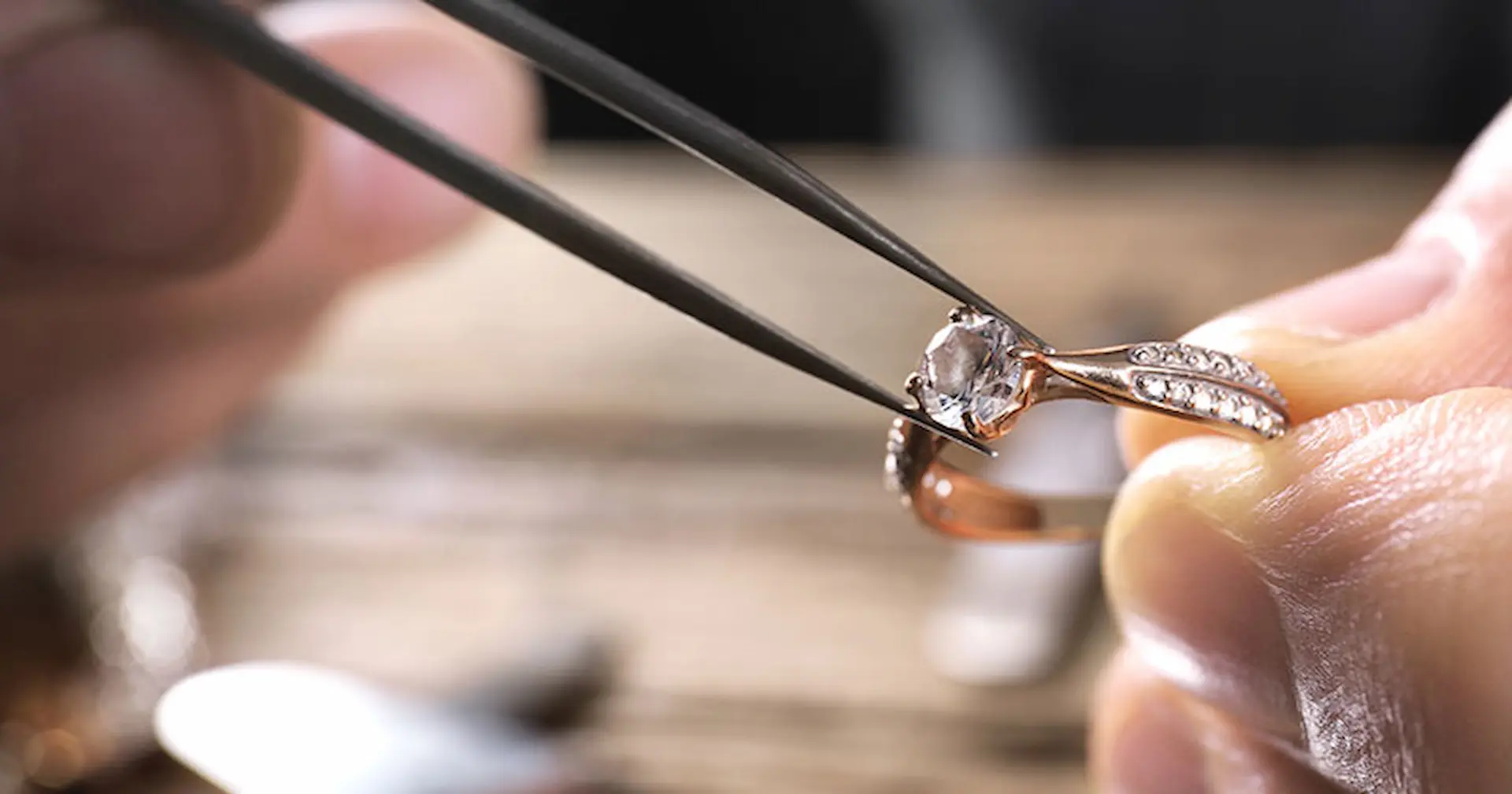
Real jewelry carries proof: a hallmark stamped into the metal, a certificate from an accredited lab, or an invoice from a jeweller who stands behind the piece. Check those three things first, and you can confirm most jewelry in minutes — before reaching for a magnet or a home test kit.
Start with the hallmark
Every genuine piece of precious-metal jewelry carries a small stamped mark. Look for it on the inside of a ring band, the clasp of a bracelet or necklace, or the post of an earring — a magnifying glass helps.
- Gold: numbers like 999 (24K), 916 (22K), 750 (18K) or 585 (14K). “GP” or “GF” means gold-plated or gold-filled, not solid gold.
- Silver: “925,” “STERLING,” or “FINE SILVER.”
- Platinum: “PT950,” “950,” or “PLAT.”
- No stamp at all is a warning sign. So is a stamp that looks shallow or uneven. A real hallmark is cut cleanly into the metal, not printed on top.
Three simple tests you can do at home
These won’t replace a lab certificate. But they catch the obvious fakes:
- Magnet test: gold, silver, and platinum are not magnetic. If the piece is pulled strongly toward a magnet, it likely contains base metal.
- Float test: drop the piece in a glass of water. Solid gold sinks immediately because of its density; anything that floats or sinks slowly is probably plated or hollow.
- Scratch test (last resort): a gentle rub on unglazed ceramic leaves a gold streak on real gold and a black streak on fakes. Only try this on an inconspicuous edge — it can mark the piece.
None of these are conclusive on their own. A piece that passes all three still isn’t “certified” — it just isn’t an obvious fake.
When to get it professionally tested
Some pieces are worth real money: an engagement ring, a gemstone piece, an item you inherited. Skip the home tests for these. Go straight to a jeweller. Professionals use:
- XRF spectrometry: reads the exact metal mix with X-rays. It doesn’t damage the piece.
- Acid testing: a controlled reaction that confirms karat. It takes training to do safely. Done wrong, it can mark or damage the metal — leave this one to a jeweller, not a home kit.
- For diamonds and coloured stones, get a certificate from an accredited lab such as GIA or IGI. It should cover the cut, colour, clarity and carat weight. It should also confirm whether the stone is natural or lab-grown.
Certificate of authenticity vs. appraisal — two different answers
Buyers mix these up all the time. But they answer two different questions:
- Authenticity confirms the piece is what it claims to be: real gold, a real diamond, from the maker stated. It does not put a price on it.
- Appraisal puts a money value on the piece, for insurance or resale. It assumes authenticity is already settled.
If you can only get one document when you buy, get the certificate of authenticity. You can always order an appraisal later. You can’t prove a piece is genuine after the fact without one.
Buy from a jeweller who stands behind the piece
A home test can catch an obvious fake. It can’t catch a karat that’s slightly off, or a treated stone the seller didn’t mention. That’s what a trustworthy jeweller is for. Before you buy, from Kooheji or anywhere else, it’s fair to ask for:
- The hallmark and karat stated in writing on your invoice, matching the stamp on the piece itself.
- A lab certificate for any diamond or gemstone piece, not just a verbal assurance.
- A clear return or exchange policy, in case something doesn’t match what you were told.
Do you already own a piece that raises questions? A family heirloom, a resale purchase, anything without paperwork? Don’t rely on a home test alone. Book an appointment with a Kooheji jeweller for a proper look first.
Buying vintage or antique jewelry? Add these checks
Resale and antique pieces carry risks new jewelry doesn’t. Hallmarks wear down. Stones get replaced. Designs sometimes mix styles from different eras.
- Check that the design style matches its claimed era: Art Deco, Victorian, Edwardian. A mismatch between style and date is a common sign of a mislabeled piece.
- Look for hand-finishing: slight asymmetry, hand-engraving. Mass production doesn’t replicate these. See our note on what real craftsmanship looks like up close.
- Ask for the seller’s history and any past appraisal paperwork. No paperwork at all? Get it professionally verified before you buy, not after.
FAQ
How do I verify if jewelry is real?
Check the hallmark stamp first (750/18K, 925, PT950), then try the magnet and float tests as a quick sanity check. For anything valuable, have a jeweller confirm it with proper equipment before you rely on a home test alone.
How much does it cost to get jewelry authenticated?
It depends on the piece and the jeweller. Metal testing costs less than full gemstone certification. Ask directly rather than assume a fixed price. Book an appointment for a quote specific to your piece.
What is a jewelry authenticator?
Someone trained to examine hallmarks, craftsmanship, and materials — usually a jeweller or gemologist — and confirm whether a piece is genuinely what it’s represented to be. This is different from an appraiser, whose job is pricing rather than verification.
How do I identify my jewelry?
Start with any hallmark stamp, then check your invoice or certificate of authenticity if you have one. If the piece has neither, a jeweller can identify the metal and stones directly.
Can I authenticate jewelry myself, or do I need a professional?
Home tests (hallmark check, magnet, float test) can flag an obvious fake, but they can’t confirm exact purity or catch a treated gemstone. Treat home tests as a first filter, and a jeweller’s equipment as the actual confirmation for anything valuable.



 Contact Us
 My Account
 Find a Boutique